Sunday, August 18, 2013

Cultural Reflections about Catching the Bus in Cuba

Sometimes the littlest things can say a lot about a culture.  One of the most interesting everyday cultural customs that made a large impression on me in Cuba was how lines for buses worked in the bustling capital city of Havana.  As a student in Washington DC, I'm no stranger to waiting in line, and at first the lines in Havana seemed similar to what I'm familiar with, though usually longer.  In particular, on one of the major avenues near the house we were staying in, there was always a large, quasi-linear-but-mostly-disorderly mass of people waiting on a stretch of sidewalk that went on for at least a whole city block.  My first week in Havana, I assumed that this was just  a popular location to catch the bus, and that this large conglomeration of people would swarm toward the bus, vying for the limited number of spaces like outbound workers in downtown Washington DC at the end of the day.  But later on in my stay in Havana, I learned that this wasn't the case, for two reasons.

                The first reason is that that's not how lines for the bus work in Havana.  I was made aware of this fact by a new friend who had been studying in Havana for a semester, as we were running late to catch the historical cannon-firing ceremony at the fort in Old Havana.  When we approached the bus stop, he said "el ultimo?" to the seemingly chaotic, dispersed group of fifteen or so people waiting.  A woman raised her hand, and he explained that the purpose of his inquiry was to find out who was the last in line, the person who had arrived most recently to the stop before us.  So I learned that what looked like a disorganized crowd waiting to board the bus was actually an orderly, fair, and respectful system.  I thought back to times in the United States when I was late for something, or exiting a stadium after a crowded sporting event, and thus tried to dart around others and push to the front of the crowd and in general hold my own in the survival-of-the-fittest struggle that is too many people trying to compete for limited spaces.  In Havana, even if I were running late for an important meeting, I would still be bound by the cultural custom of "el ultimo?" in the bus line.

                To me, this was a simple example of how Cuba's governing philosophies of socialism and solidarity manifest themselves in some of the most basic, uncomplicated daily events.  Another man approached the stop, said those same two words, and this time I raised my hand.  As the bus pulled up, an orderly, single-file line emerged from the apparent chaos.  Even if they were late, or were really tired and wanted to be guaranteed a seat instead of having to stand, nobody complained, nobody pulled the cut-the-line move that I sometimes seethe at yet sometimes perform myself.  Everyone simply remained calm, knowing that they would get to their destination.  There were no thank yous; passively and patiently falling in line for the bus according to the order you arrived is not something polite, it's something normal.  


                ... And the second reason that the bus line near our house was not as I had initially perceived it?  The giant mass of people that always seemed to be waiting on that one block wasn't for a bus... as I later learned, the people were waiting for Coppelia, famous Cuban ice cream (which was featured in the famous Cuban film Fresa y Chocolate).  Though I never found time to try that ice cream, I was still left with something sweet - the knowledge that eventually, everyone in line would get a taste.

Monday, August 12, 2013

US Foreign Relations with Socialist Nations

The United States’ unwillingness to engage in diplomatic relations with Cuba is hard to justify. It’s not because Cuba is socialist – the US interacts with other socialist nations. It’s not because there has been war between Cuba and the US – relations between socialist Vietnam and the US have been reestablished since the Vietnam War. One of the few explanations might be the stubbornness and unwillingness to compromise of both nations – the result of decades of US bullying and Cuban defensiveness.

Relationship between the US & Self-Declared Marxist-Leninist Countries
The US’s largest foreign creditor, major trade partner
No official diplomatic relations
Open foreign relations
Ended relations after the Vietnam War, reestablished in 1995


Socialismo en Cuba

Photo Credit: Moses Jackson


In the United States, socialism and communism are emotion-packed, confusing, scary terms. They evoke dark, grainy photos of war and intimidating portraits of Lenin and Stalin. Cuba prompts similar reactions from many Americans – visions of Fidel Castro and the Cuban Missile Crisis.

Foreign relations between the US and Cuba are muddled by lack of information and outdated biases – largely on the part of Americans. One of the biggest huddles seems to be the hang-up on Cuba’s governance style, which if looked at objectively would soothe any misgivings Americans might have.

Cuba has a socialist government that is run by the communist party. Not the authoritarian Russian communist party of the Cold War, but an evolved, modern and even democratically inclined party in a socialist system where citizens vote for representatives at all levels. Cuban socialism isn’t about tyranny and unchecked state ownership and control – if it was, I have no doubt that the Cuban revolutionary spirit would have overthrown it in a fashion much like the revolution of 1959 [which was based on socialist ideals during a time when Cuba desperately lacked economic equality and adequate social safety nets].

However, socialism has been given little room to flourish in Cuba. The US-imposed economic blockade has effectively cut Cuba off from the global trade and financial assistance needed to building a strong nation [regardless of governance]. The blockade – inherently anti-socialist and anti-Castro – asserts that the economic challenges in Cuba are the de facto failed outcome of socialism. The UN General Assembly, however, recognizes the role of US policy in Cuba’s hardships and has called for an end to the blockade for the past 21 years, calling it “archaic” and “punitive.” Despite the blockade, socialist Cuba has maintained its egalitarian ideals and with fewer resources, all citizens make due with less.

Socialism [and the Cuban nation] should cease to be seen as a threat to US democracy and freedom. It’s time to move beyond the Cold War and embrace one of our [geographically] closest neighbors.

US suppression of Cuban freedoms needs to be recognized as a crime against humanity within the United States. It’s time to end the blockade.

In his writings, Ché Guevara explores Cuba as a vanguard in the resistance of US hegemony in Latin America. He highlights exceptional aspects of the Cuban revolution, while noting that “it fundamentally followed a logic derived from laws intrinsic to the social process.” It’s time to take Ché’s analysis and turn it back on ourselves. We stand at a strategic moment in time when we can act as the vanguards to influence social process again – towards improved foreign relations with Cuba [and ultimately a closer look at neocolonialism and imperialism].


My generation has no memories of the time when socialism and communism were an actual threat to the US. And, based on my experience in Cuba, I feel that it is my responsibility to dispel any misgivings about the country and its government. During our trip, we heard from professors who identified themselves as members of the communist party. They were friendly and open and struck me as oddly… normal. Cubans were eager to engage and had an astounding ability to differentiate between the American people and senseless policies of the American government. Rather than treat me [an American] with animosity for all the suffering my country has inflicted upon them, they were enthusiastic and happy to chat. After such understanding, I cannot comprehend how we continue to harbor negative feelings about this nation. Perhaps that is the greatest accomplishment of the blockade, prohibiting the flow of people and ideas and not allowing US citizens to experience and make their own opinion about Cuba. 

------
“There is talk about the failure of socialism, yet where is the success of capitalism in Africa, Asia, and Latin America? Where is the success of capitalism in places where thousands of millions of people live? I believe that the failure of capitalism should be discussed as much as the failure of socialism in a small number of countries.  Capitalism failed in more than 100 countries, which now face a truly desperate situation. I do not understand why this is forgotten. There is talk about the failure of socialism based on what happened in East Europe. Capitalism has ruined the world. It has poisoned the rivers, the seas, and the atmosphere; it is destroying the ozone layer, and it is disastrously changing the world's climate.”
--Fidel Castro

Saturday, August 10, 2013

Dogs, Chicks and Hemmingway

Expect the unexpected when in Cuba.

Like perros on the roof, keeping watch. 

Or farm animals roaming at look-out points. This mother hen squawked about with her cute baby chicks in tow. Can you find all nine among the leaves, or wait maybe there's 10. 

Seeing where our food comes from was one of the neatest experiences. Who knew coffee beans grew on trees and pineapples grew in groves? Avocado, banana, mango and lime trees were also abound in the countryside. Not something we see everyday here in the good old suburbia of Crofton, Maryland.


Sometimes I felt like we were being watched... not by the government, but by the faces in the mountains.

This is one of the many memorials locals had erected in tribute to the Cuban Five, most of who remain jailed in the US for espionage.


I was not expecting to meet famous author Ernest Hemmingway in Cuba, but alas he was waiting for us at Floridita, a bar he would frequent for daiquiris during his numerous stays in Havana. The daiquiris were outstanding and the band that stopped in was quite lively! I could see why he would come here for escape and inspiration. Don't you love the photograph on the wall of Hemmingway whispering to Fidel Castro? Wish I knew what he was saying...


The Hills Have Eyes into the Soul of Cuba


Cuba is a magnificent place, now more than 50 years beyond The Revolution and currently in the throes of an evolution.  While fascinating, visiting Cuba has also left me feeling dejected – feeling that somehow I’ve been duped by my very own government and by the U.S. media. Perhaps it is my own fault for having only scratched the surface of knowledge about Cuba until now, and perhaps there is still more to explore about true U.S. motivations regarding Cuba.

Because Cuba is a socialist country, unlike the democratic one I am most accustomed to, I found myself curiously questioning every little thing, acting like a child learning new sights, learning a new language, and learning new rules and ways to do things. While I found enlightening answers through the expert lecturers, professors, tour guides, and new Cuban colleagues and friends I met on my visit, somehow the country still eludes the definitive nature of my consciousness. Answers only brought more questions. Maybe it is actually all quite simple, similar to what I found perched on the mountaintop in Viñales, which has remained a prominent memory of my trip – a house and a lizard.

All week these two objects have stuck in my mind as magnificent and symbolic of Cuba’s struggle, strength, and beauty.

A family used to live in this house, literally on a mountain, and farm on the very steep hillside. The trek and climb to get to this point was intense, and I was astonished and awe-struck when the house appeared after our treacherous journey. As serene as the weather was on this day, apparently the impact of storms and hurricanes is twice as worse when you live on a mountain, and it was that very thing that forced the family who used to live here to move inland. But because the government owns the land, there is no real estate market for selling the property and so instead it sits empty until the government passes it along to someone else. Trouble is, Cubans are highly educated and so the younger generation isn't interested in the hard life of farming, let alone living on a mountain to do so. As beautiful as this scenery was, I can't say I blame them.

On one of the rocks in front of the house, I spotted this curly-tailed lizard whose speckled stripes and shadow reminded me of the duality of Cuba. People unfamiliar with Cuba may see it as a little country with a dark past, but once they see Cuba in the light and not in the shadows cast upon it by those with disdain, it becomes impossible to miss its rich beautiful splendor and powerful determination to thrive and succeed. And by the way, check out those claws! I say make friends, not foes. 

Tuesday, July 23, 2013

More Pictures

Old cars, known as máquinas, are prevalent as cheap, unofficial taxis in Havana.

A line of máquinas at a stoplight in Old Havana.

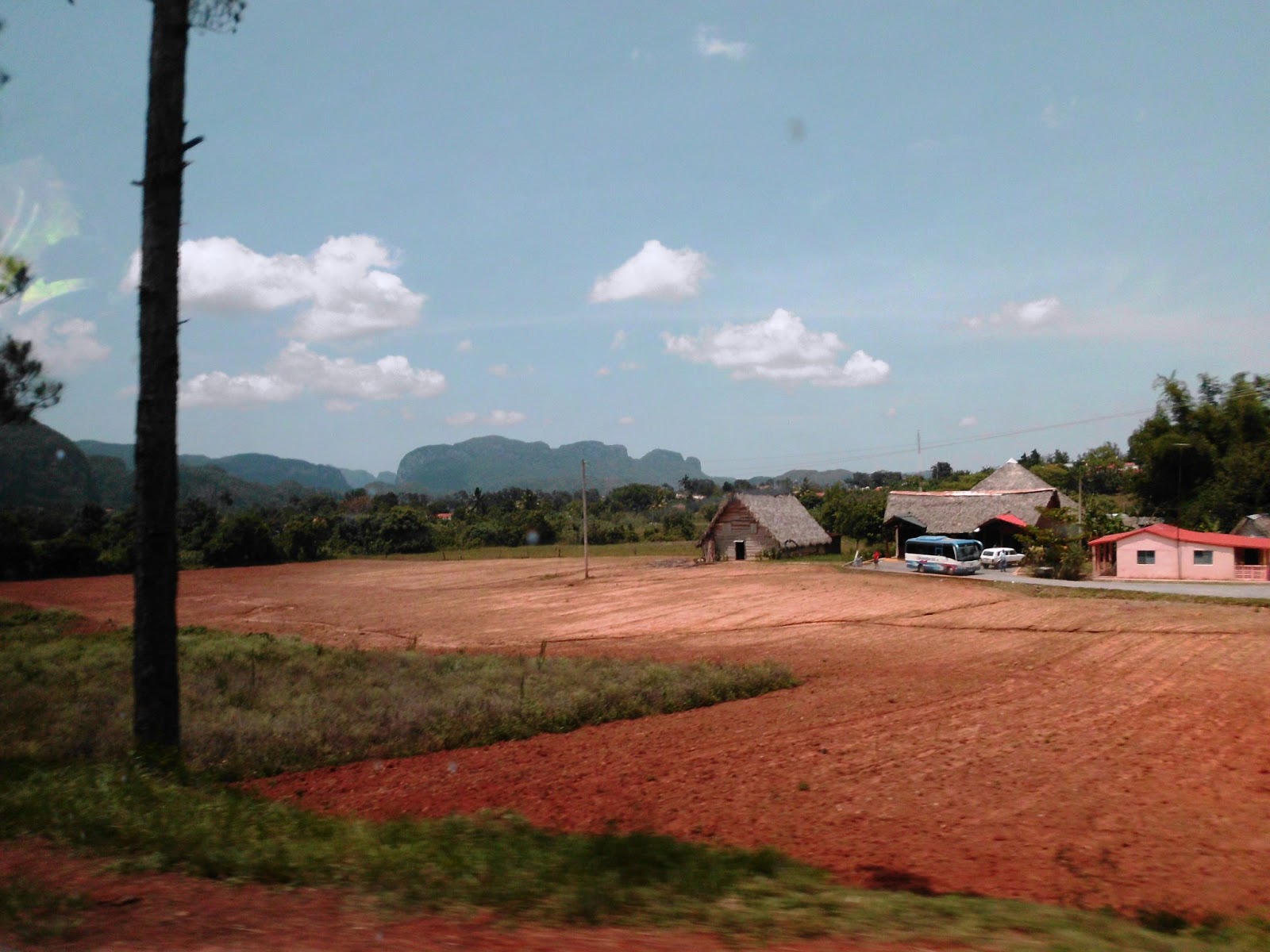
A farm in rural Viñales, where some of the best tobacco in the world is produced.  The building in the center of the picture is a drying house for tobacco leaves.

A storm rolling in over Havana.

The Capitol building is in the center.

Cubans normally drink their coffee black, very sweet, and in small portions.

Approaching New Havana from Old Havana.  Some of the bigger buildings visible are large hotels. 

Monday, July 8, 2013

A few snapshots of Havana and Viñales Valley

Beautiful 1950's cars driving around town

University of Havana


Exploring Habana Vieja with Professor Graddy

Old Havana

Viñales Valley